Fine motor skills and coloring: what it does and what it does not do
Written by the Amy Color Club editors with the help of AI and checked by us.
Coloring uses the small muscles of the hand, which is a normal part of school and home life. What you can say about it, what you cannot, and which pages to choose.
"Fine motor skills" means the use of the small muscles in the fingers and hands. Writing, cutting, doing up buttons and coloring all depend on them. This article explains what coloring does for those skills and what it cannot do, followed by practical tips.
To be clear from the start: this article gives general, widely accepted ideas and practical tips. It does not give medical advice, and it does not promise any developmental outcome. If you have a concern about your child's hand skills, talk to your child's teacher or doctor.
What coloring practices
Holding a crayon or pencil means finding a grip: the tool between thumb and index finger, with the other fingers resting nearby. A child practices that grip each time they color. They also practice pressure. Press too hard and the paper tears. Press too lightly and the color barely shows. Over time, a child learns what works.
Coloring also asks the hand and the eye to work together. You look at a line and keep the crayon on the spot you want. That is a skill children use in writing and drawing too.
What it does not do
Coloring is a pleasant activity, not a training program with a guaranteed result. A child does not become smarter, calmer or a better reader just from coloring. Coloring also does not replace help if a child has difficulty with their hands. If there is a real concern, the right step is to ask a professional.
For schoolwork in particular, coloring prepares the hand but does not teach writing. Children learn letters by writing them, so pair coloring with letter practice.
Choose pages for the stage
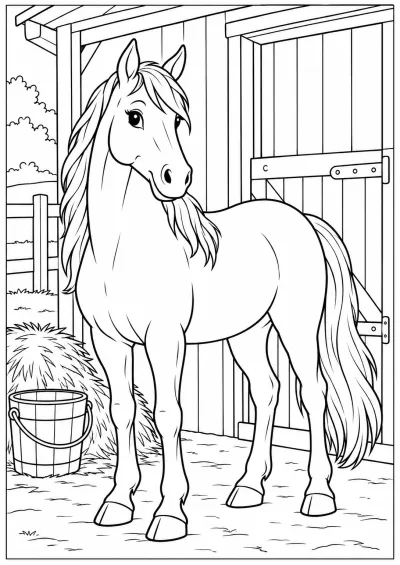
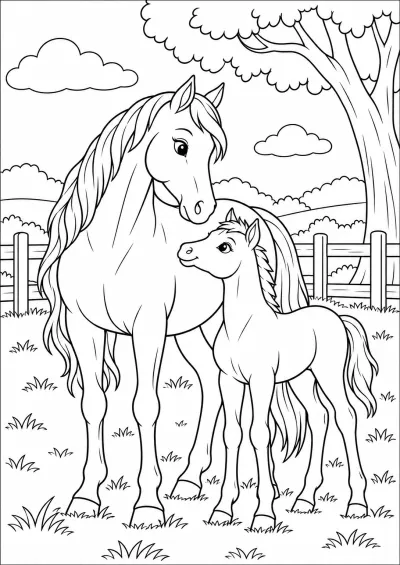
When a child is still building control, start with large areas. The horse by the stable and a mare and her foal have wide shapes that a child can fill without worrying about the edges.
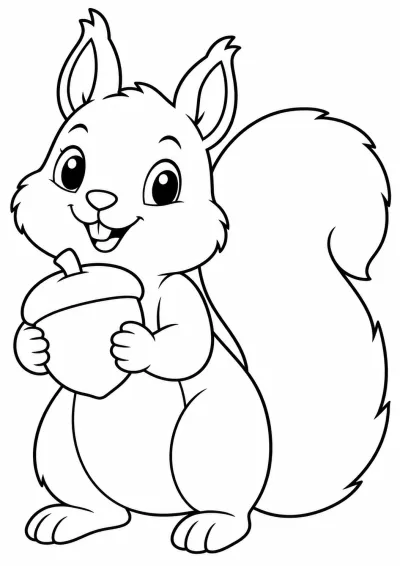
When the child is more confident, add more lines and small pieces. A squirrel with an acorn asks a little more precision.
The easy coloring pages list shows the pages with large shapes, and the flower pages and tree pages show how much detail a page can hold. Use them to pick the next step.
Practical tips
- Sit well. Let the child sit upright with the feet on the floor and the arm on the table. That leaves the hand free to move.
- Keep the paper still. A strip of tape on the corners stops the page from sliding. Then the child can focus on the crayon.
- Use thick tools. A thick crayon or a triangular pencil sits better in a small hand than a thin pencil.
- Keep it short. A few minutes at a time is a good start.
- Let the child choose. Choosing the page and the colors often keeps a child going.
Coloring is a good companion to other activities
Coloring works well next to other hand activities such as cutting, stringing beads and drawing shapes. Mix them up over the week, so the child uses different movements and does not get bored.
Adding a name to the finished page is a good next step as well. The child can practice writing letters on something they care about.
To finish
Coloring is an ordinary, pleasant activity that exercises the hand and the eye together. Choose a page that suits the child's stage, keep sessions short and let the child lead. The overview of all coloring pages has pages for every level.